

Change Management as a Competitive Edge in Manufacturing
Why manufacturers need adoption, workforce readiness, and execution discipline to turn technology investments into measurable performance.
Manufacturers are operating in a year where the cost of standing still is rising.
Tariff rules are still shifting. Input costs remain under pressure. Supply chains are being affected by trade policy, geopolitical risk, longer lead times, and material constraints. At the same time, manufacturers are being asked to modernize faster through ERP, automation, AI, smart manufacturing, analytics, cybersecurity, and supply chain visibility.
That is a lot of change to absorb at once.
It is also why change management in manufacturing should be treated as a competitive edge.
The Institute for Supply Management reported that the U.S. Manufacturing PMI registered 52.7% in April 2026, indicating a fourth straight month of expansion, while the Prices Index reached 84.6%, its highest reading in four years (Institute for Supply Management). ISM also noted that 46 commodities were reported up in price and just one was reported down, showing how much cost pressure manufacturers are managing in the current environment (Institute for Supply Management).
For manufacturing leaders, the issue is not only whether the business can afford transformation.
The bigger question is whether the business can afford transformation that does not stick.
Cost pressure and transformation pressure are happening at the same time
Manufacturers are dealing with cost pressure while still needing to invest in better systems, better data, and better ways of working.
That creates tension.
Leaders may need to reduce manual work, improve supplier visibility, increase productivity, strengthen planning, or protect margins. But they also need to manage limited resources, workforce constraints, and operational risk.
Tariff uncertainty adds another layer.
Avalara’s 2026 tariff update notes that tariff policies remain volatile and that businesses must be prepared to institute tariff changes quickly to stay compliant and avoid disruption (Avalara). Avalara also reports that, despite a May 2026 Court of International Trade ruling affecting Section 122 tariffs, Customs and Border Protection continues to apply and collect those tariffs for all but the three named plaintiffs while an administrative stay remains in effect (Avalara).
For manufacturers, this uncertainty affects more than procurement.
It can affect supplier decisions, landed cost, pricing, inventory, finance, production planning, and customer commitments. It can also affect which transformation projects leaders approve, delay, accelerate, or redesign.
When cost pressure rises, every project faces more scrutiny.
Leaders need to know:
- Will this initiative reduce manual work?
- Will it improve planning visibility?
- Will it help teams respond faster to supplier or tariff changes?
- Will it improve data quality?
- Will it protect margin?
- Will people actually use the new process?
That last question is where change management becomes essential.
Technology creates potential, but adoption creates value
Manufacturers are not slowing down on technology.
They are evaluating where AI, automation, analytics, connected systems, and factory modernization can improve productivity, visibility, and resilience.
BCG’s 2026 Factory of the Future analysis says AI-enabled production setups are changing conversion costs and can unlock productivity savings of up to 60% (Boston Consulting Group).
That is a significant opportunity.
But the opportunity does not realize itself.
BCG also argues that competitiveness now depends on the ability to deploy advanced manufacturing operations, achieve their productivity benefits, and align those capabilities with the broader footprint (Boston Consulting Group). In other words, technology, operating model, workforce capability, and execution have to move together.
Prosci’s digital transformation guidance, updated in 2026, makes the point clearly: “Digital tools create potential. People turn that potential into performance” (Prosci).
That is the heart of the issue.
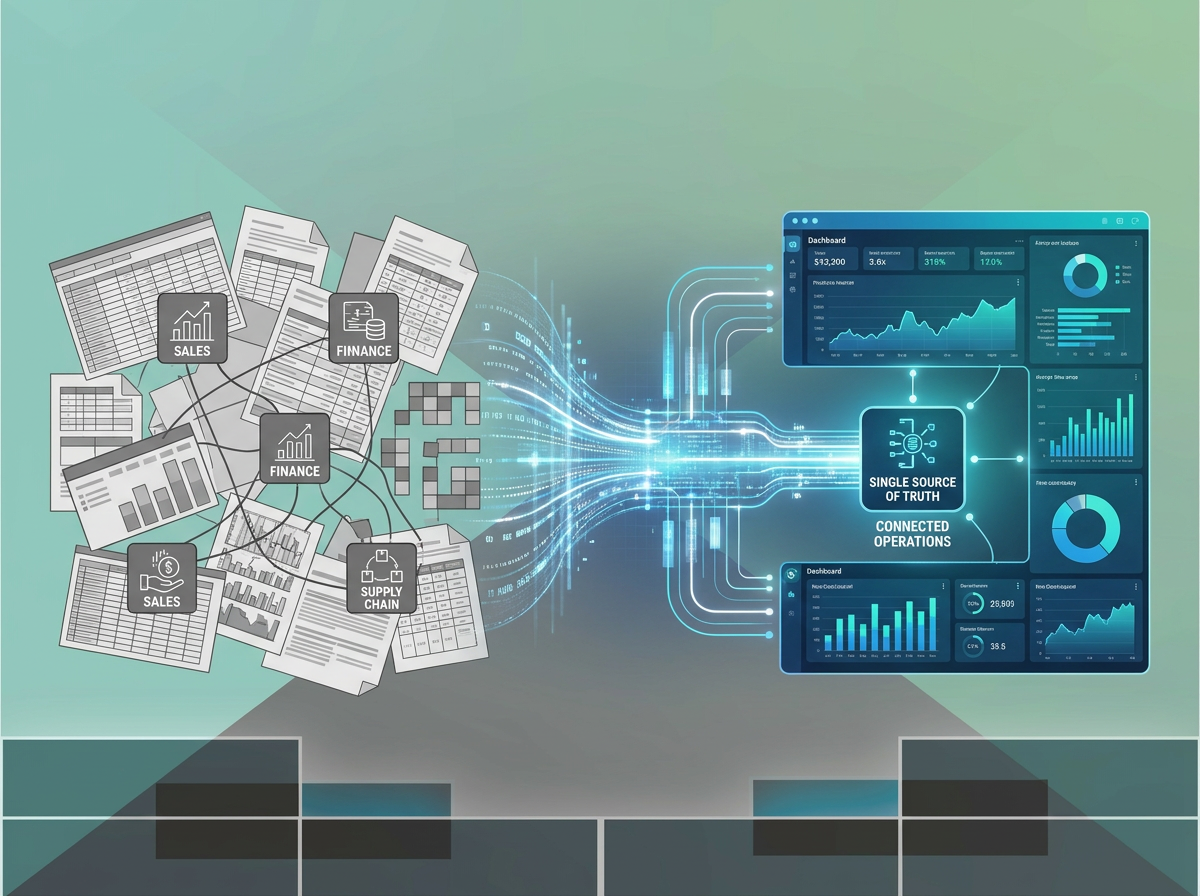
A new ERP process does not improve execution if teams keep using side spreadsheets.
A new supplier risk dashboard does not help if buyers do not update or trust the data.
A new AI tool does not improve productivity if employees are unclear about when to use it, how to validate it, or how it changes their role.
A new automation workflow does not protect margin if supervisors and frontline teams do not understand the new handoffs.
The hidden risk is not always the system.
The hidden risk is adoption.
Change management is a business performance discipline
Change management is often described as helping people accept change.
That is true, but incomplete.
In the current manufacturing environment, change management also helps protect business performance. It gives leaders a structured way to prepare people, adjust processes, reinforce expectations, and measure whether the change is being used.
This matters because transformation value is often lost in the space between project completion and day-to-day adoption.
Prosci notes that ROI must account for adoption metrics because even advanced solutions will not deliver value without widespread use (Prosci).
That means change management should answer practical questions:
- Who is impacted by the change?
- What work will each role do differently?
- What decisions must sponsors make early?
- What data will teams need to trust?
- Which managers need to reinforce the new process?
- What training is needed by role?
- What adoption metrics will show whether value is being realized?
These questions are not soft.
They are operating questions.
They affect cost, quality, speed, resilience, and customer commitments.
Workforce readiness is part of the execution gap
Manufacturers are also facing a workforce readiness challenge.
Technology ambitions are increasing, but workforce capability may not always be keeping pace.
PwC’s 2026 industrial manufacturing workforce analysis says companies expect technology enablement and automation to more than double by 2030, while 70% of industrial manufacturing executives rank developing new capabilities internally as their top way to access growth opportunities (PwC).
PwC also warns that manufacturers may have blind spots in digital and data infrastructure, workforce upskilling and reskilling, and analytics and decision intelligence (PwC).
This is why change management cannot wait until go-live.
If a transformation changes how people plan, buy, schedule, produce, report, analyze, or make decisions, then workforce readiness is part of the delivery plan.
Training should not only explain the tool.
It should explain the new way of working.
Managers should not only be informed.
They should be equipped to reinforce expectations, answer questions, and remove barriers.
Sponsors should not only approve the investment.
They should stay visible long enough to help the organization adopt the change.
Tariff response is also a change management issue
When tariffs or trade rules shift, manufacturers often need to change sourcing strategies, pricing assumptions, supplier relationships, inventory policies, and cost analysis routines.
Those changes affect people.
Procurement may need new supplier evaluation criteria. Finance may need updated landed-cost models. Sales may need guidance on pricing conversations. Operations may need different inventory planning assumptions. Executives may need faster scenario planning and escalation routines.
If each function responds separately, the organization may move quickly but not coherently.
Change management helps connect those actions.
It creates a common message. It clarifies ownership. It helps teams understand what is changing and why. It gives leaders a way to monitor adoption before breakdowns become operational problems.
In a volatile year, that discipline matters.
Five leadership moves for manufacturers
(1) Connect change to the current business pressure
Do not explain the transformation only in system terms. Explain how the change supports cost control, margin protection, supplier resilience, productivity, planning visibility, or customer response.
(2) Prioritize the changes that matter most
When teams are already managing tariffs, cost pressures, and resource constraints, leaders should focus on changes that deliver clear business value and avoid overloading the organization with low-value activities.
(3) Build adoption into the project plan
Do not wait until go-live to discuss adoption. Plan role impacts, communication, manager enablement, resistance management, training, and adoption measurement early.
(4) Measure usage and business outcomes
Track whether people are using the new process, whether data quality is improving, whether cycle times are changing, and whether the expected business value is appearing.
(5) Treat change management as a capability
Manufacturers will continue facing overlapping changes. The organizations that build repeatable change capability will be better positioned to adapt without losing execution discipline.
Leadership questions to ask now
Before launching or revising a manufacturing transformation effort, leaders should ask:
- Which business pressure is this change helping us address?
- How are tariffs, input costs, labor constraints, or supplier risks changing the priority?
- Which roles will need to work differently?
- What behaviors must change for the project to succeed?
- Which managers need to be equipped first?
- What data will teams need to trust?
- How will we measure adoption?
- How will we measure value after implementation?
- What risks will appear if adoption is slow?
These questions help shift the focus from project completion to business performance.
Conclusion
Manufacturers are not operating in a stable environment.
Tariffs, rising input costs, workforce constraints, technology change, and supply chain volatility are forcing leaders to make faster and better decisions.
In that environment, change management is not optional.
It is how manufacturers turn transformation into execution.
It is how they help people adopt new ways of working.
It is how they protect value when every dollar matters.
Technology can create the possibility of improvement, but change management helps turn that possibility into measurable performance.
At CYR Consulting, we help manufacturing leaders move from strategy to execution by bringing structure, accountability, and practical delivery support to complex transformation initiatives.
If your organization is preparing for an ERP, AI, smart manufacturing, supply chain, or operational transformation initiative, now is the time to assess whether your change management approach is strong enough to support adoption and measurable value.